Made with Tertin · 5 slides
Jazz: A History of Reinvention
Five slides tracing jazz from New Orleans roots through swing, bebop and later reinvention.
Published
About this example
A visual history example built around roots, acceleration, reinvention and the music today. Original AI-generated historical claims are retained and have not been independently fact-checked.
Reviewed example created with Tertin. Copyedited for publication.
Open the reviewed presentation
Open or download the reviewed HTML presentation to inspect the slides in your browser. The published slide previews were rendered from this reviewed copy.
Every slide, with its text
Open a preview to see it at full size. Read the text from the published presentation beside each image to explore the content as well as the design.
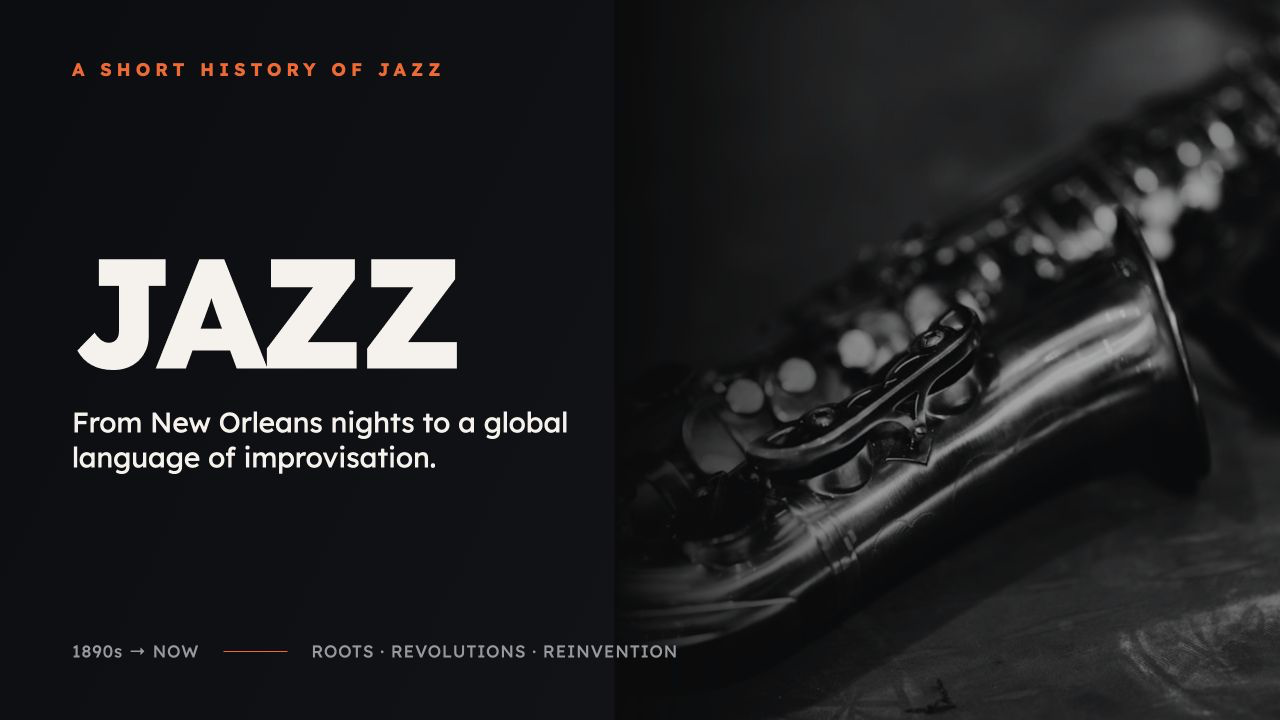
1. JAZZ
Text from the published presentation
A short history of jazz
JAZZ
From New Orleans nights to a global language of improvisation.
1890s → NOWROOTS · REVOLUTIONS · REINVENTION
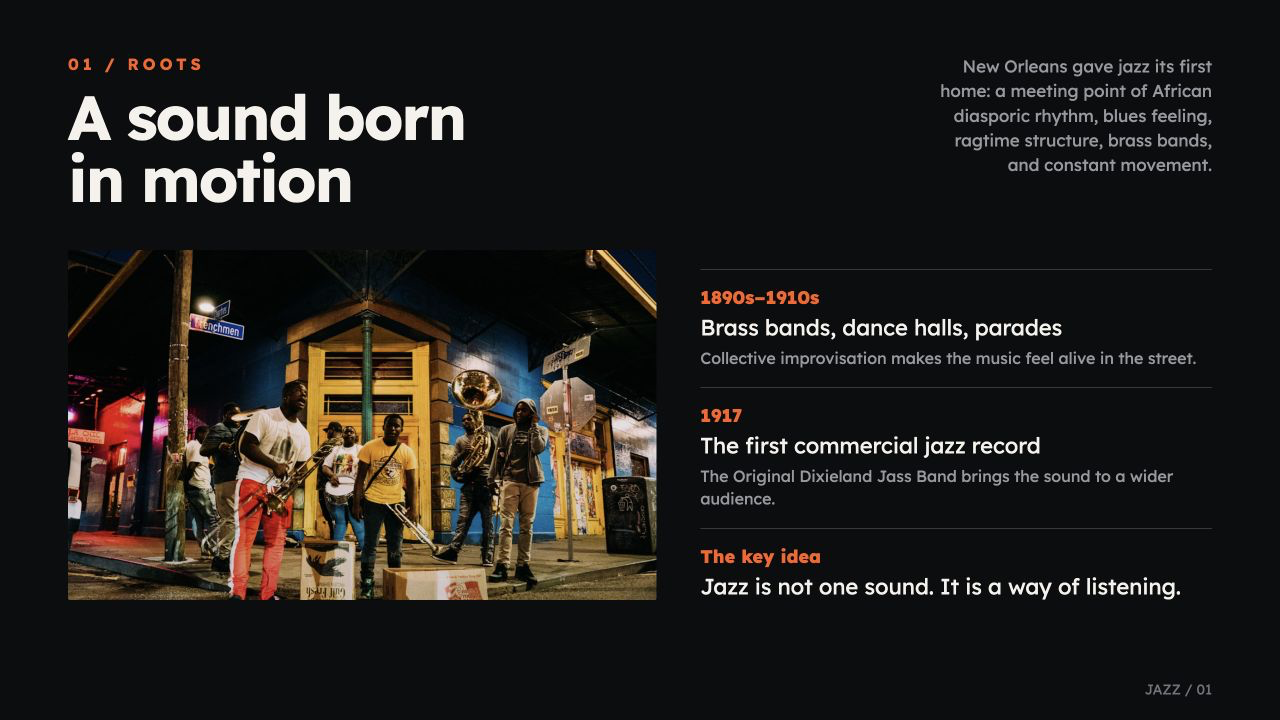
2. A sound born in motion
Text from the published presentation
01 / ROOTS
A sound born
in motion
New Orleans gave jazz its first home: a meeting point of African diasporic rhythm, blues feeling, ragtime structure, brass bands, and constant movement.
1890s–1910s
Brass bands, dance halls, parades
Collective improvisation makes the music feel alive in the street.
1917
The first commercial jazz record
The Original Dixieland Jass Band brings the sound to a wider audience.
The key idea
Jazz is not one sound. It is a way of listening.
JAZZ / 01
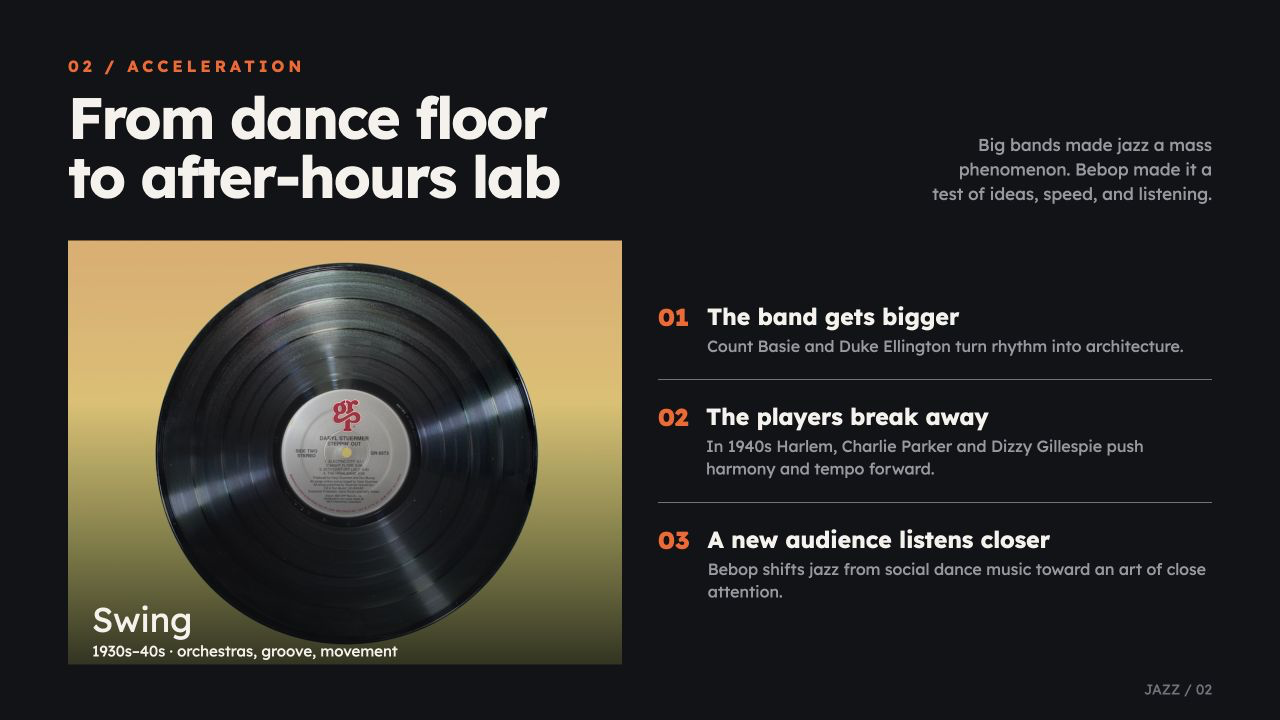
3. From dance floor to after-hours lab
Text from the published presentation
02 / ACCELERATION
From dance floor
to after-hours lab
Big bands made jazz a mass phenomenon. Bebop made it a test of ideas, speed, and listening.
Swing
1930s–40s · orchestras, groove, movement
01
The band gets bigger
Count Basie and Duke Ellington turn rhythm into architecture.
02
The players break away
In 1940s Harlem, Charlie Parker and Dizzy Gillespie push harmony and tempo forward.
03
A new audience listens closer
Bebop shifts jazz from social dance music toward an art of close attention.
JAZZ / 02
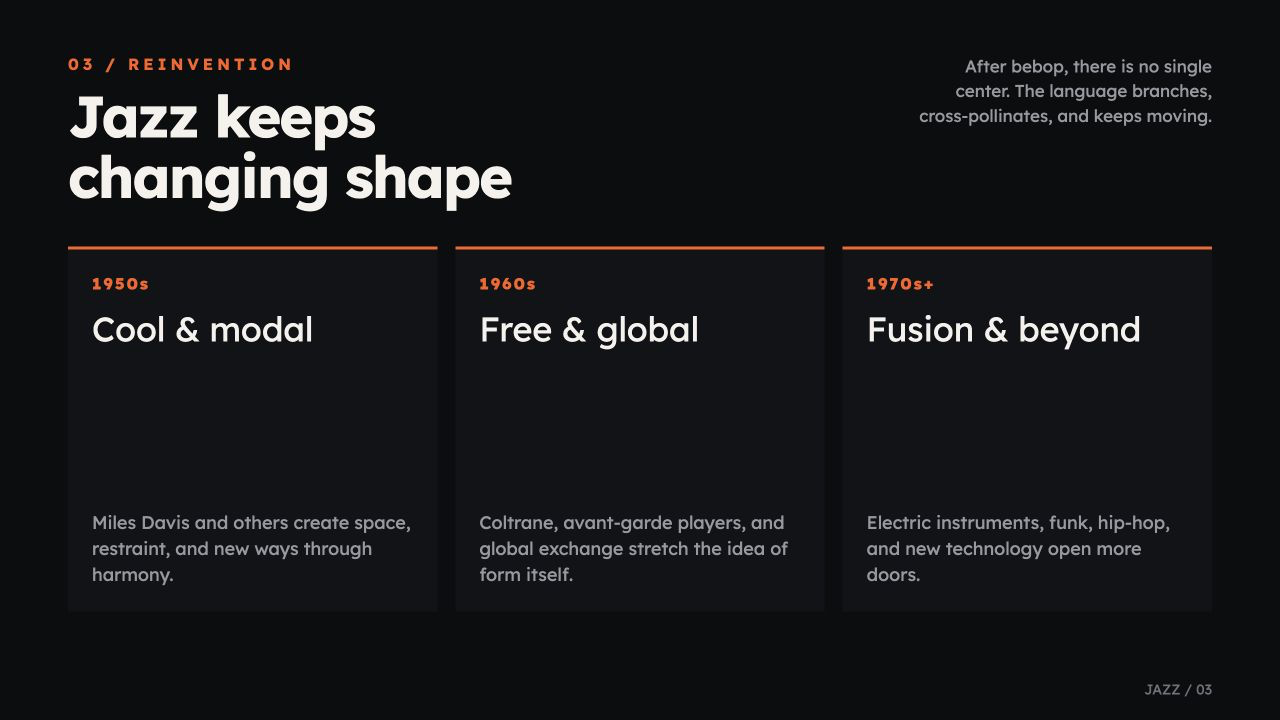
4. Jazz keeps changing shape
Text from the published presentation
03 / REINVENTION
Jazz keeps
changing shape
After bebop, there is no single center. The language branches, cross-pollinates, and keeps moving.
1950s
Cool & modal
Miles Davis and others create space, restraint, and new ways through harmony.
1960s
Free & global
Coltrane, avant-garde players, and global exchange stretch the idea of form itself.
1970s+
Fusion & beyond
Electric instruments, funk, hip-hop, and new technology open more doors.
JAZZ / 03
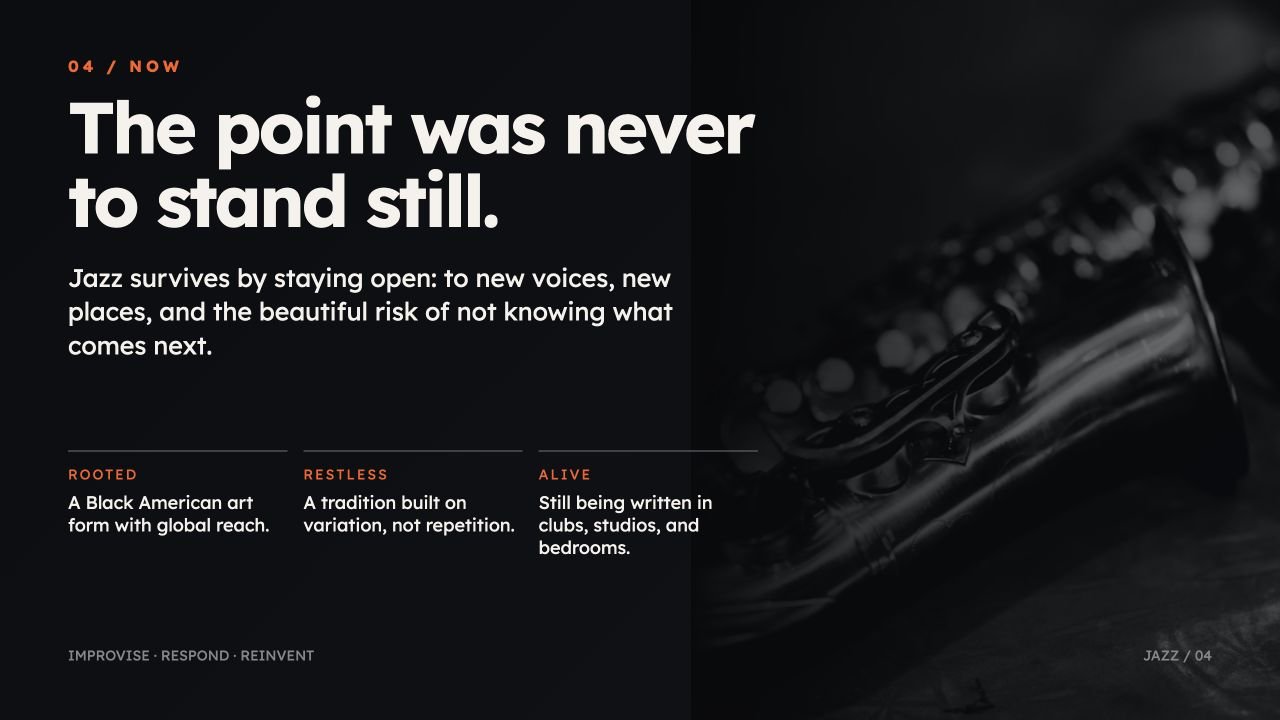
5. The point was never to stand still.
Text from the published presentation
04 / NOW
The point was never
to stand still.
Jazz survives by staying open: to new voices, new places, and the beautiful risk of not knowing what comes next.
ROOTED
A Black American art form with global reach.
RESTLESS
A tradition built on variation, not repetition.
ALIVE
Still being written in clubs, studios, and bedrooms.
IMPROVISE · RESPOND · REINVENTJAZZ / 04